


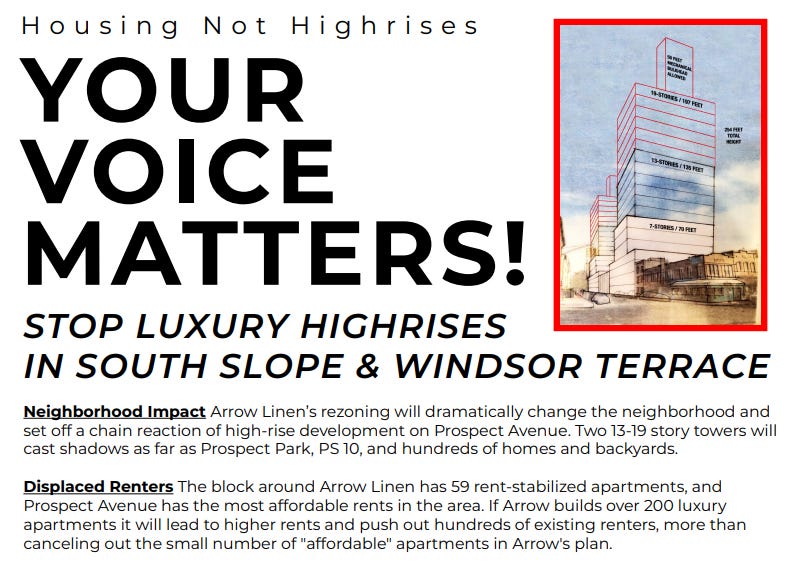
“STOP LUXURY HIGHRISES,” declared a flyer opposing the Arrow Linen redevelopment in southern Park Slope. The campaign calls itself Housing Not High-Rises, as though the high-rises contained something else.
The flyer offers no evidence for its prediction that expensive new apartments would raise nearby rents. Research has found the opposite: Xiaodi Li’s 2020 study of New York City high-rises estimated that a 10 percent increase in housing stock within 500 feet lowered nearby rents by about 1 percent relative to the counterfactual.
But identifying the apartments as “luxury” also invites the reader to regard housing rich people as a harm in itself. Suppose these apartments improved their occupants’ lives and did absolutely nothing for poorer households. What would be good about preventing that advantage? Derek Parfit’s Levelling Down Objection asks generally, what is good about reducing inequality when nobody benefits?
Parfit illustrates the problem with blindness. Suppose some people can see and others cannot. Blinding the sighted would eliminate the inequality, but restore nobody’s vision. Preventing new apartments does not redistribute them. If poorer households gain nothing, the achievement is purely in denying someone else a place to live.
Giving poorer people’s needs greater weight does not require assigning everyone else’s gains a value of zero. Whether blocking a project prevents displacement or not is a separate question. But a politics that promises housing should have something better to offer than satisfaction that the wrong people did not get access to a home.
Clearly, adding housing reduces housing costs relative to the counterfactual. This is what (nearly) all the studies show, and it is also common sense. We need to build a lot more supply, especially where people want to live. Housing opponents rarely challenge this point - they simply insist that the project belongs in a different neighborhood.