


Local residents report being harassed by squatters in a public park, while activists chant “Die Yuppie Scum” and narrativize the harm as “Class War.” It sounds like the battle for Fort Greene Park in 2014 Brooklyn but Tompkins Square Park did it first, on the Lower East Side in 1988, during NYC’s comeback from its 1975 fiscal crisis.
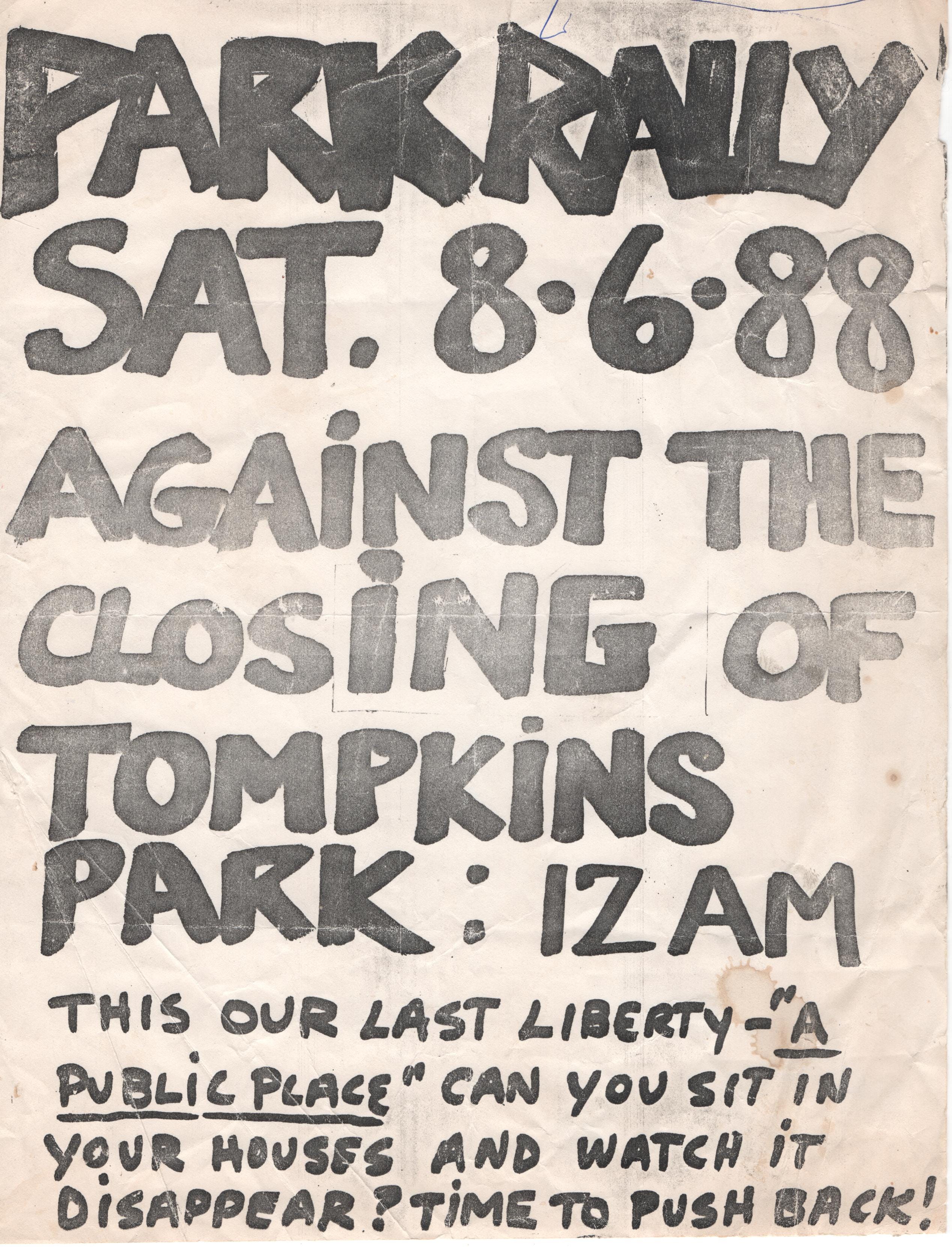

This sort of confrontation can be productive, according to sociologist Richard Sennett. In The Uses of Disorder (1970), he proposes it can help people mature:
The most direct way to knit people’s social lives together is through necessity, by making men need to know about each other in order to survive. What should emerge in city life is the occurrence of social relations, and especially relations involving social conflict, through face-to-face encounters. […] A social forum that encourages the move into adulthood thus first depends on making sure there is no escape from situations of confrontation and conflict.
But the commonest conflict with a squatter is not confrontation. It is Ellickson’s chronic street nuisance: conduct that breaks the norms of a public space, persists over a protracted period, and “no more than annoys.” His paradigm is the squatter who occupies the bench with a shopping cart every morning and sleeps there until dark.
No passerby suffers more than a moment’s annoyance, so no passerby complains. Yet over an hour, hundreds of people are denied the option to sit, and this nuisance compounds over weeks. The squatter adds one person to the plaza’s headcount, but the public space’s overall headcount falls, because fewer people wish to linger there.
The pedestrian who confronts the squatter bears all the risk of the encounter and shares the benefit with every other user of the plaza. Unlike a disturbance of the peace, a chronic nuisance rarely moves any onlooker even to call the police. Sennett’s productive confrontation is the one act no stranger has a reason to volunteer for.