


New York has been buying public space with zoning since 1961. A developer who builds a plaza can earn additional floor space by ceding some of the lot as “Privately Owned Public Spaces,” or POPS. The city has collected nearly 600. Making sure they are used has been a struggle since the early 1970s, when the sociologist William Whyte set up cameras and found most of these plazas empty most of the day.
The chairman of the City Planning Commission watched the footage and decided on tougher zoning, the seating rules of 1975. Builders were required to add seating and food and keep plazas near street level.1 A pattern began of putting new requirements on owners and asking nothing of users. To the extent that Whyte acknowledged user misconduct at all, it was to condemn retailer prejudice against “undesirables.”2 His reframe proposed: “It is the measures taken to combat them that is the problem.”
Owners pushed back, and in 1979 they won the right to apply to lock certain plazas and arcades at night. At 1114 Sixth Avenue, the owner of the Grace Building hired guards for its plaza. In 1981 the building put up a fence; the city subsequently forced it down. In 1985 police arrested 21 drug users and dealers at the plaza in a single raid.
Night closing spread through amendments to the Zoning Resolution in 1993 and 1996. Today an owner who wants to gate a Privately Owned Public Space at night must document “significant safety issues,”3 and the gate must be see-through, no taller than five feet, and removed every morning.
By day, owners armored the furniture. In the late 1990s, City Planning surveyors found required seating “disabled by spikes.” In 2007 the city banned anything fixed to a ledge or step to keep people from sitting. The same rewrite let owners post rules of conduct, but not rules against lingering or eating.
The city’s next theory of the empty plaza: maybe people don’t know they’re allowed in?
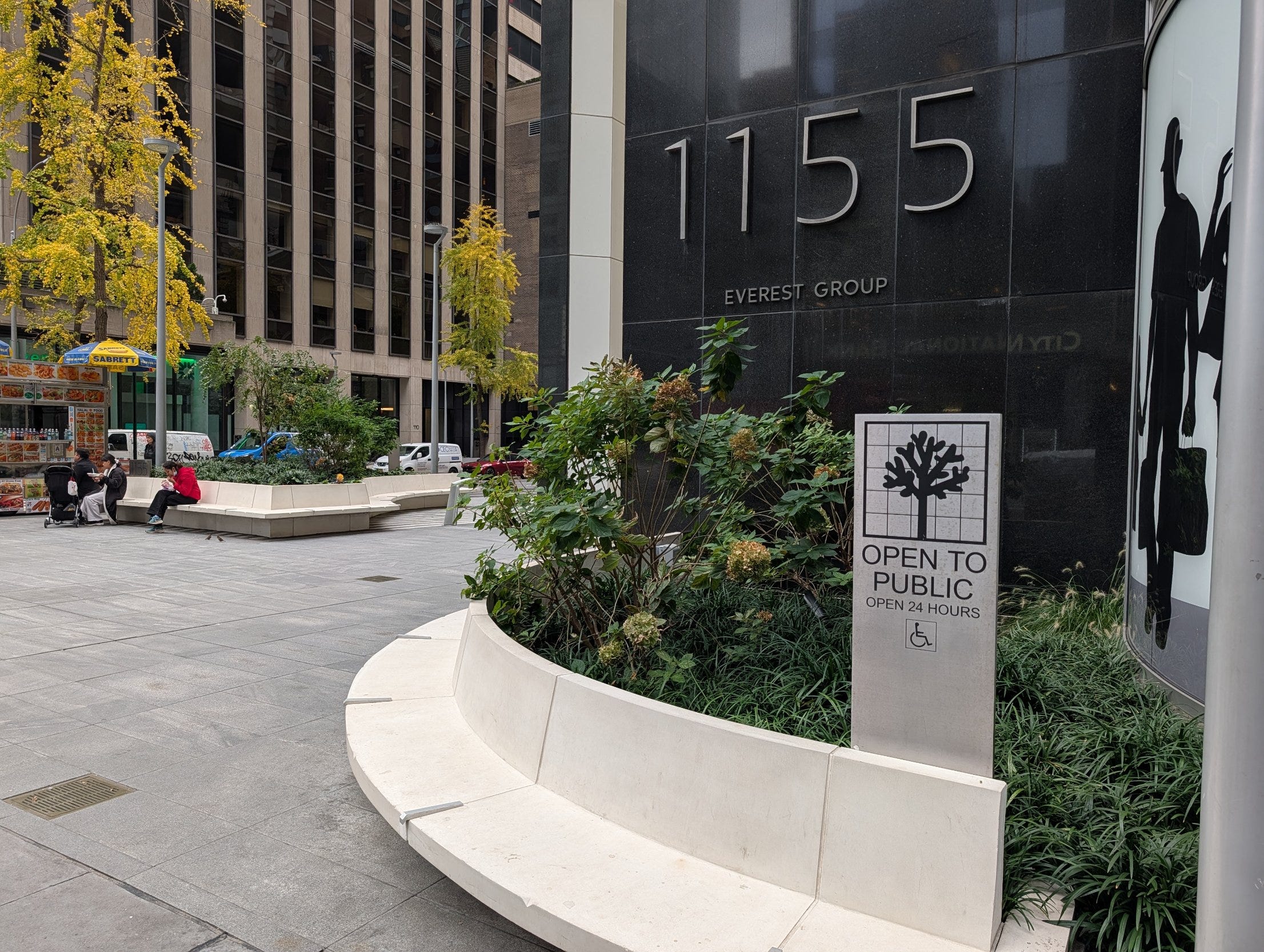
Older spaces had never been required to say they were public, and the Buildings Department looked only when someone complained. In April 2017 the Comptroller’s auditors found that nearly half the city’s spaces had no duty to post one.4 That June the Council passed Local Law 116. Every space now posts its hours, the amenities it owes and a 311 number, which inspectors come to verify at least every three years.
Rule by rule, the city went further than Whyte, who thought a good plaza could lock its gates at night.5 The city’s own parks close from 1 a.m. to 6 a.m. Bryant Park, a bustling tourist hot spot, closes every night. Across Sixth Avenue, the Grace Building’s plaza still may not. The city can force a space to stay open, but not full.
Among them, one linear foot of seating for every 30 square feet of plaza. William H. Whyte, The Social Life of Small Urban Spaces (1980), p. 39.
Whyte gives a whole chapter to the defense of “undesirables”: “Who are the undesirables? For most businessmen, curiously, it is not muggers, dope dealers, or truly dangerous people. It is the winos, derelicts who drink out of half-pint bottles in paper bags—the most harmless of the city’s marginal people, but a symbol, perhaps, of what one might become but for the grace of events.” (p.60)
For example, in 2019 the Planning Commission let One Penn Plaza lock overnight, but only after the owner documented drug deals and assaults on its plazas and human waste and used condoms in the planters.
Auditors found 151 of the 333 locations built before any sign rule. In its 2023 report the Buildings Department logged 178 complaints and found nine spaces in violation.
Whyte thought the all-hours access rule “a bit too stiff”; his model parks, Paley and Greenacre, close at night (p. 125).