


The 18th Amendment to the U.S. Constitution enshrined alcohol Prohibition in 1919. The 19th barred denial of the vote on account of sex in 1920. Overlapping reform networks like the Women’s Christian Temperance Union helped organize for both.
Preachers and reformers in Western New York and the Middle West looked on with dismay at rapid social and technological change, urbanization, and immigration. Newly minted Americans with unusual foodways and folkways gathered in beer halls and saloons to drink, find work, and build social worlds outside the church and home.
The WCTU looked at all this conviviality and found an alcohol Theory of Everything. Alcohol was made upstream of lost wages, battered wives, neglected children, crime, prostitution, machine politics, workplace accidents, and hyphenated-Americanism.
Frances Willard became WCTU president in 1879 and adopted a strategy called “Do Everything.” Once temperance was identified as the cause of social decay, the organization had acquired reasons to intervene far beyond the saloon. By 1896, twenty-five of its thirty-nine departments were working on causes other than temperance.
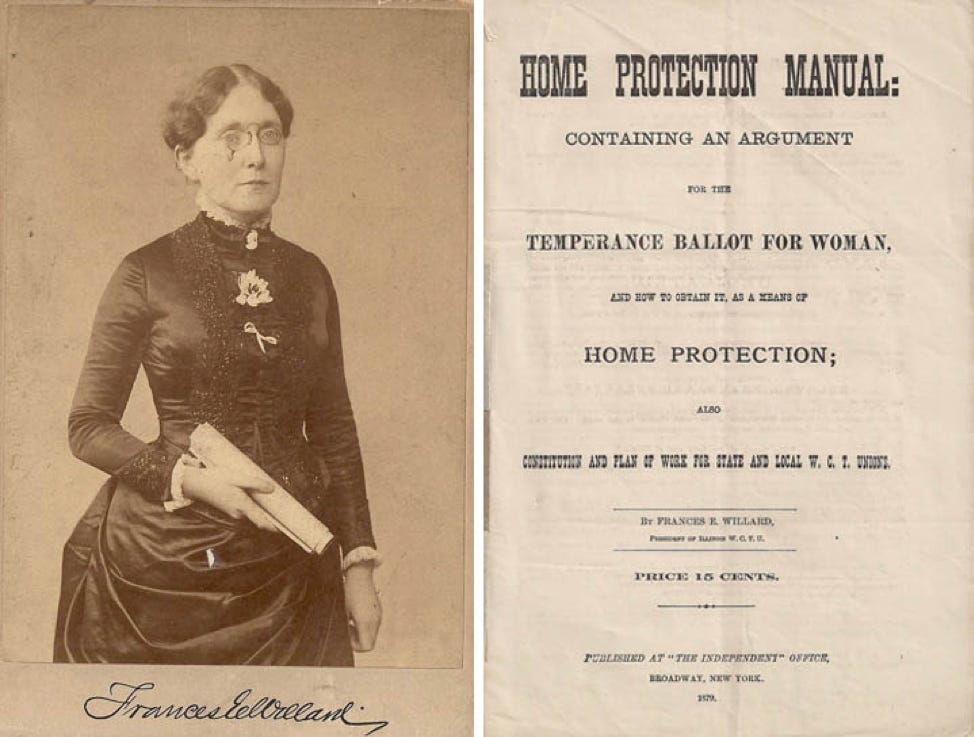
The WCTU’s first lesson was organizational. The Women’s Temperance Crusade of 1873-74 could put hundreds of praying women into saloons and replicate the tactic across 900 communities, but churches and temperance groups soon complained that the method was too costly and labor-intensive to produce lasting change. The WCTU was founded in 1874 to give the temporary mobilization a permanent organization.
Mary Hunt supplied the next upgrade. After uneven success persuading school boards, she pushed the WCTU toward compulsory Scientific Temperance Instruction through state law. Her goal was “thorough text-book study” of alcohol’s effects; local unions pressured boards, campaigned for legislators, packed hearings, and monitored implementation. Temperance had moved from the prayer hall into physiology class.
The important innovation was setting the standards. A revival could only ask adults to repent. A school curriculum could teach children what alcohol was before they had formed an opinion about it. Once the WCTU learned how to turn a moral claim into a mandated subject, an approved textbook, and a teacher qualification, “Do Everything” looks less like ideological sprawl than a factory for laws built from proven techniques.