


Since 1967, the right of a homeless person to disturb “by their presence the sensibilities of residents of nicer parts of the community” has been affirmed by New York’s highest Court of Appeals. The court ruled the matters “more properly objects of the welfare laws and public health programs than of the criminal law,” and preemptive arrests unlawful.
In the city, this disturbing of sensibilities most frequently happens on the subway. Panhandlers prefer to sleep on lightly-policed trains over more rule-bound shelters.1 This disturbing conduct continues despite a ban on begging in the subway, which passed a free speech challenge in 1990 (Young) and survived again in 1993 (Loper).
The rules underground address conduct, not presence. Like lying outstretched to take up multiple seats, or fare evasion. In 2019 the Subway Diversion Program (SDP) offered homeless riders ticketed for doing either a deal: accept a referral to free services and the civil summons (ticket) disappears. That ticket is not a criminal charge.
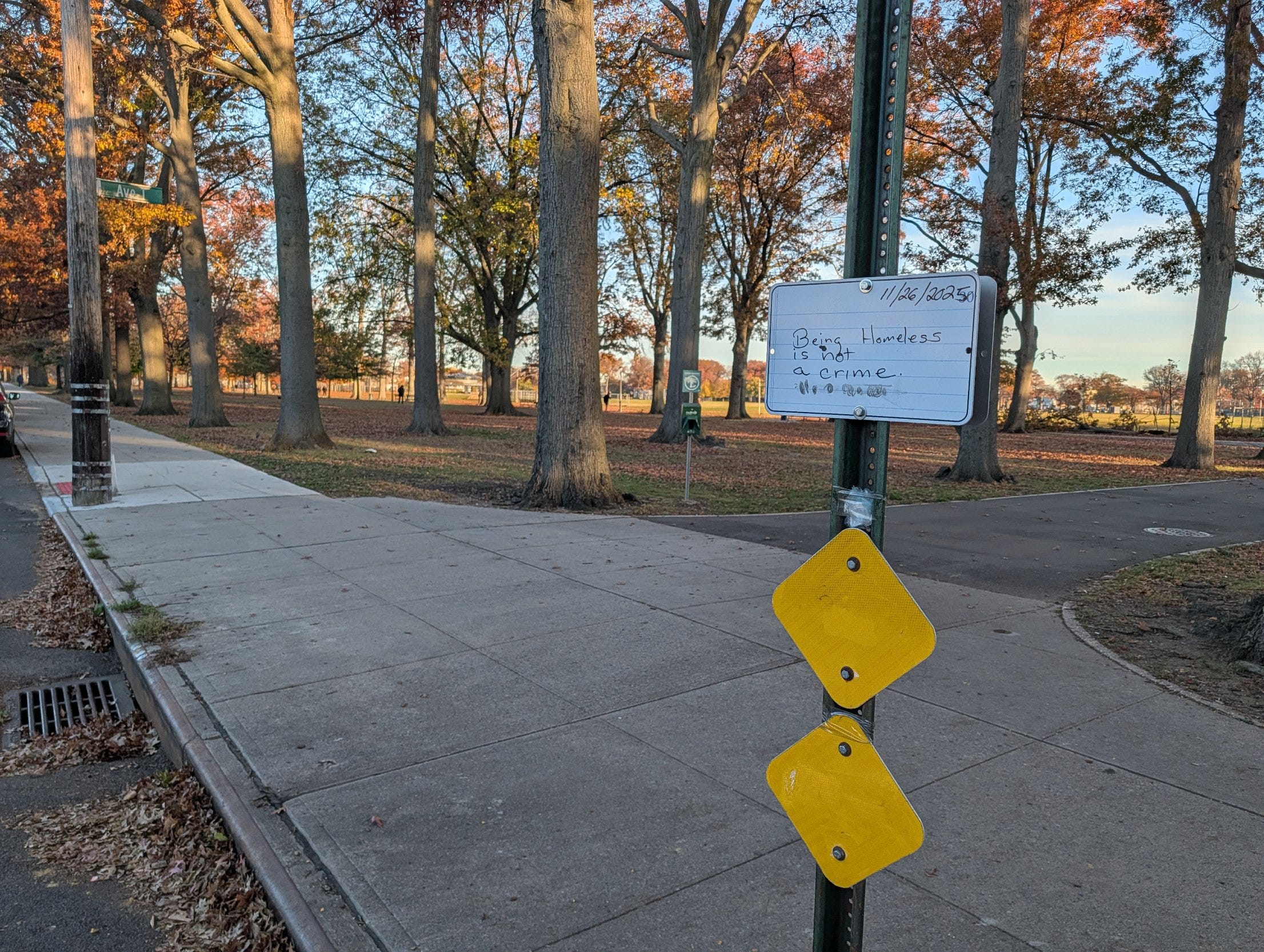
The Coalition for the Homeless said the program would “further criminalize homeless New Yorkers.” Like the park sign, which answers a charge nobody made, the claim to reverse “criminalization” of a class covers a concrete demand about conduct: the Coalition’s policy platform asks the city to clear the summonses from the SDP.
The Mamdani administration has put the Department of Homeless Services in charge of encampment clearances (his predecessor, Mayor Eric Adams, used the NYPD). 311 complaints about encampments now go to DHS outreach workers instead of to police. And yet the Coalition’s June report still decries “the criminalization of homelessness.”
In this arrangement, a ticket for breaking transit rules is now a coupon for services. A man stretched across three seats can trade it for an intake appointment, and if his trouble continues, the city’s Intensive Mobile Treatment teams will bring him a phone, a nurse and an apartment. The tired rider who must stand has nothing to trade.
See George L. Kelling’s 1991 article on MTA’s Operation Enforcement. The talking point that subways are “safer” than shelters is almost certainly wrong. “An average of six homeless persons a month died of preventable causes in the subway during 1989, with the worst month being December, when 14 died. On one December weekend alone, four vagrants died in the subway: One was hit by a train; a second was killed by another homeless person; and two died of hypothermia.”