


How does this picture of couples dancing in the street make you feel? Under traffic lights and painted lane markings, a multiracial crowd twirls beside brownstones. It was a long time coming for a neighborhood undergoing a rapid change in appetites. In June 2009, the Prospect Heights Neighborhood Development Council, local merchants and DOT organized four car-free Sundays, with music and children’s play.
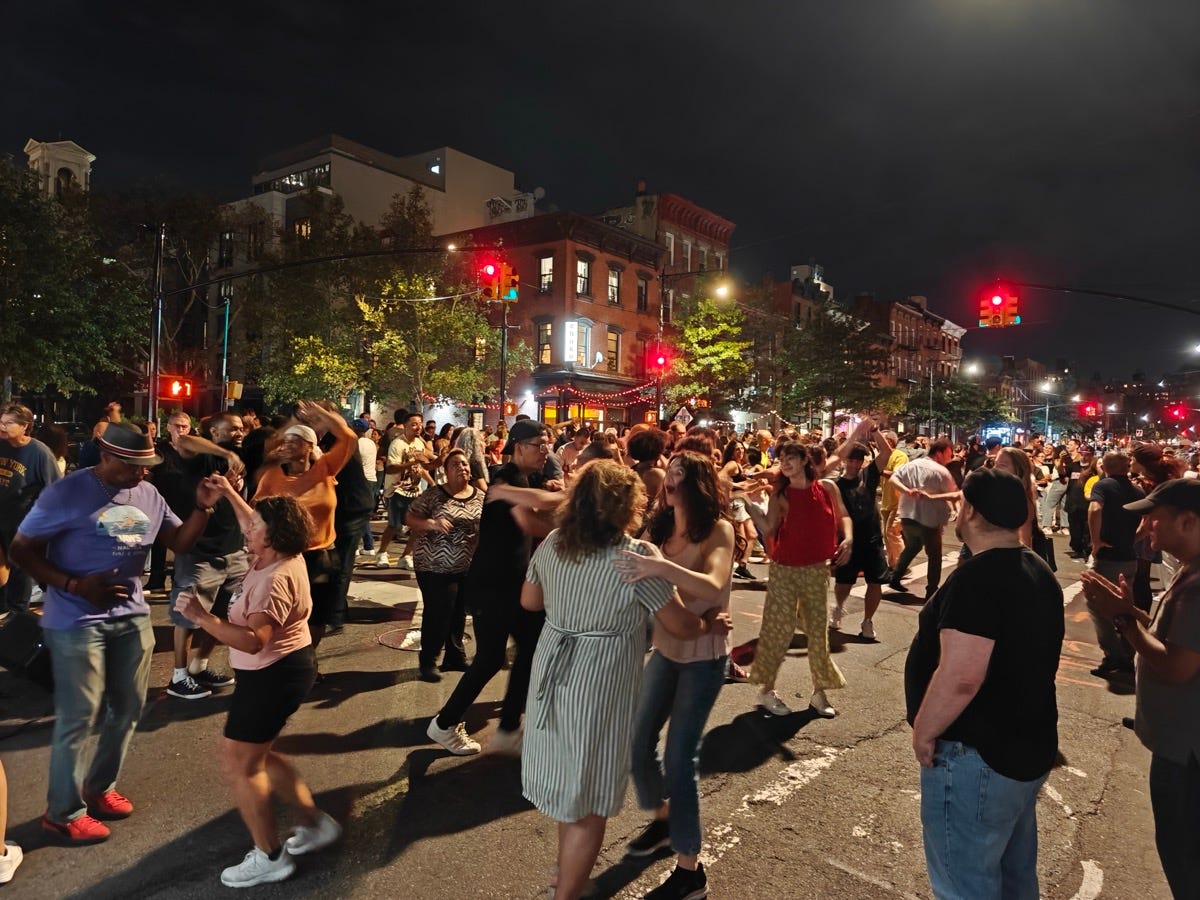
In the 2000s and early 2010s, Prospect Heights underwent rapid demographic turnover while remaining a neighborhood of roughly 20,000 people. A major driver of transformation was the New York State-backed Atlantic Yards project. Announced in 2003, the development brought Barclays Center arena and over 3,200 apartments.1
New neighbors can bring new pleasures to share.2 Open Streets temporarily close roads to vehicles to so people can walk, cycle, and gather. Portland began Sunday Parkways in 2008, Prospect Heights joined in 2009, and Los Angeles launched CicLAvia in 2010. By 2016, 122 American cities had hosted a program.
To stimulate restaurant business during the COVID lockdowns in June 2020, New York’s emergency rules let restaurants self-certify for outdoor seating3 and authorized street closures for dining. Vanderbilt, a restaurant-heavy avenue in Prospect Heights, joined the program in August. An occasional experiment became a weekend fixture.
Although the Open Streets organizers see their work as positive-sum, the United Neighbors of Prospect and Crown Heights and certain businesses like Mitchell’s Soul Food raised fears of congestion and loss of car-based business from churchgoers. PHNDC offered compromises, which were refused: “we never dine outside.”
This opposition had an ally in Eric Adams, who in 2023, paused an Open Streets redesign on Underhill Avenue, saying the city ought to listen to “long term residents.”
Zohran Mamdani campaigned on expanding Open Streets, and in June 2026, his budget proposed $6.4 million a year through 2030 for the program. Volunteers formed a new nonprofit for the 2026 season and scheduled five months of Saturdays, noon to 10 p.m. Organizers called it their first season in four years without a cut in hours.
Empire State Development reported 3,212 completed apartments, including 1,374 affordable units, in March 2026. The project used state authority to override city zoning and acquire land by eminent domain. Litigation challenged the takings and the environmental review of prolonged construction. Barclays opened in 2012; the first residential building in 2016.
PHNDC chair Gib Veconi said Vanderbilt Avenue was chosen to participate in Open Streets because of its concentration of willing businesses. In 2023, he put the cost at roughly $200,000 a summer and described it as Brooklyn's only volunteer-run Open Street. The opposing United Neighbors said program served younger, wealthier newcomers.
Before COVID, Consumer and Worker Protection licensed sidewalk cafés and approval could take four to five months. Parking lanes were generally unavailable for restaurant seating. June 2020’s order waived licensing, fees and zoning barriers for DOT self-certification. Permanent DOT licensing replaced the emergency system under a 2023 law; existing operators had to apply by August 3, 2024. Year-round roadway dining was authorized in August 2026. Open Streets became a separate permanent program in 2021.