


A culture shock I experienced living in rural Pennsylvania for a few years in adulthood was seeing neighbors burn trash in their backyards. What felt to me like a moral crime was, in front of my eyes, a party with beer and laughter and community.
Out of sight, out of mind. Wherever the wind blew the smoke, that was their problem. In 2023, wildfires in Quebec blanketed the northern United States in a red haze. Was this an Act of God or a consequence of failed cooperation between humans?
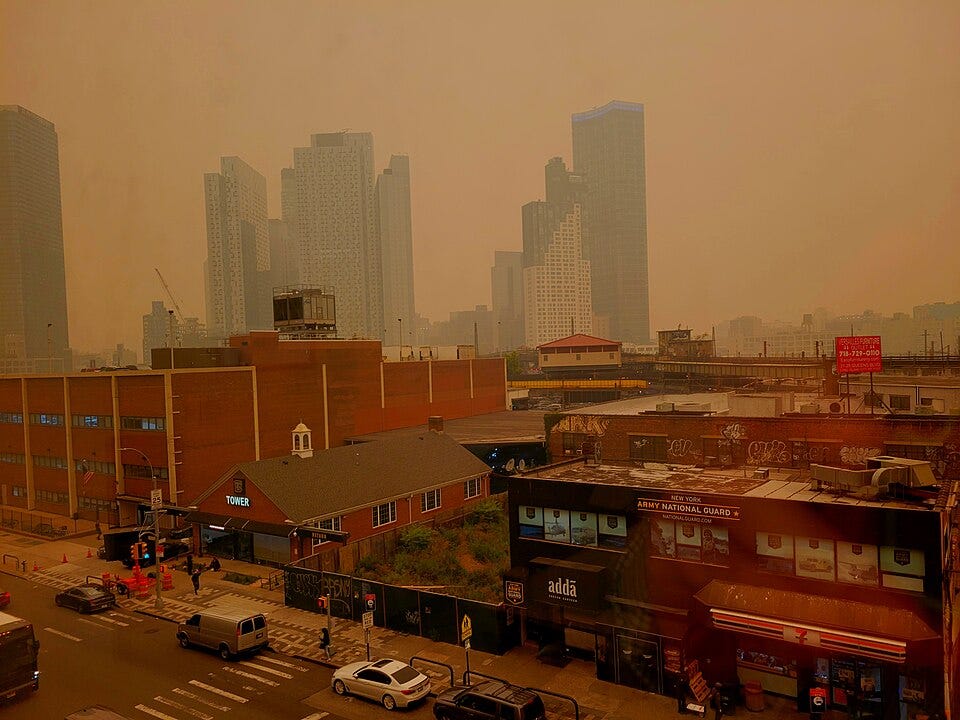
Environmental pollution is the classic negative externality: this is a cost imposed on someone who was not a party to the decision that produced it. If you live upstream on a river, dumping your washing-machine water into it may be convenient—for you.
Everyone downstream bears part of that cost.
You cannot have one-on-ones with everyone downstream. A watershed connects thousands of strangers who will never share a room. Canadian wildfire smoke crossed states and national borders. At this scale, strangers need rules and enforcement.
So we built sewers instead of relationships.
Treatment plants and monitoring systems keep households and factories at a safe distance from rivers and lungs. The achievements of environmentalism as an implemented protocol are easy to miss because the waste simply goes “away.”
Environmental activists are famous for provocative displays of moral fortitude. Their eccentricity can make environmentalism look like a lifestyle or temperament rather than a social technology. But mass society needs protocols for governing costs that travel beyond the range of personal relationships. Environmentalism teaches us to treat air, water, and soil as shared systems rather than as a dumping ground.