


Breathless punditry after the 2024 presidential election noted Republicans’ increased vote share in New York City. Although the city generally votes Democratic, who makes up these deep-red outer-borough constituencies?
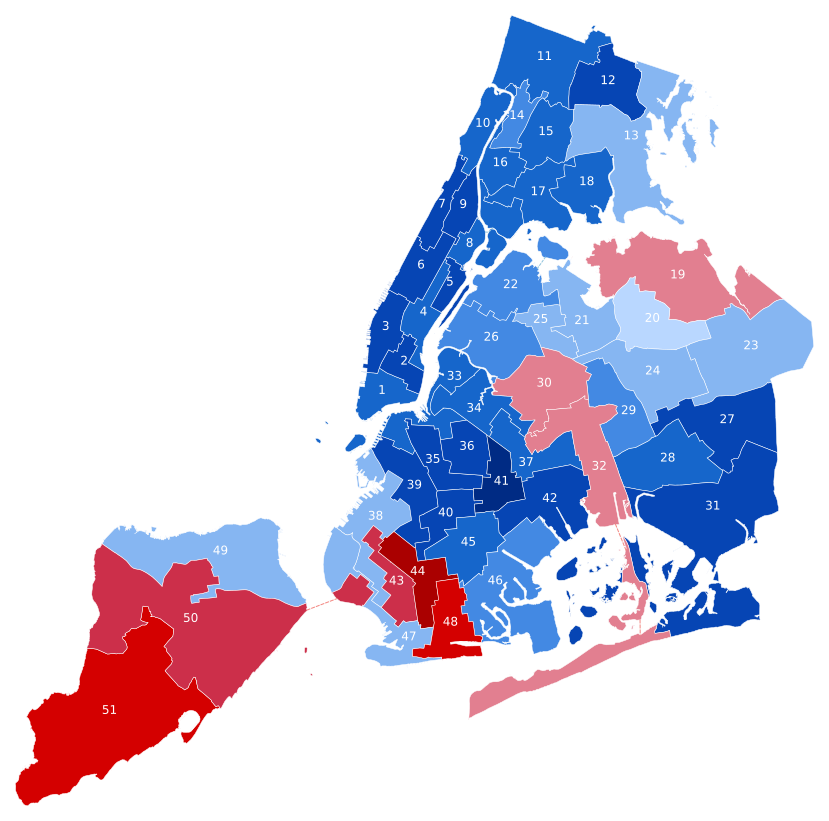
In my City Council District 48 in southern Brooklyn, Donald Trump received 72% of the vote in 2024. The only two more Republican districts were District 44, centered on the Orthodox Jewish homeowning enclaves of Borough Park and Midwood; and District 51, covering southern Staten Island.
In the famous “New York City Immigrant Enclaves” map, District 48 encompasses “Little Odessa.” Odessa references the historically cosmopolitan, city today under Ukrainian rule, which supplied many immigrants during Soviet refusenik emigration.
Although Russian is the lingua franca in this area, many Russian speakers identify more with other former Soviet countries or Israel, and you will also hear Georgian, Uzbek, and other languages. My city councilwoman, Inna Vernikov, has made national news for her unabashed Zionism and opposition to Mayor Zohran Mamdani.

In her Russophone campaigning, Vernikov talks about coming from the former Soviet Union “to escape communism” (чтобы спастись от коммунизма). She received an endorsement from the Sephardic Community Federation and helped establish Asian Community Watch, which organizes civilian patrols and safety workshops.
She voted “nay” on the “City of Yes” proposal for upzoning. For a specific proposed rezoning of 2501 Coney Island Avenue in the district, she negotiated a revision from 60 apartments and 24 parking spaces to 27 apartments and 35 spaces, citing the “character of the neighborhood” and “lack of sufficient parking.”
She also helped coordinate the clearance and fencing of a homeless encampment near Guider Avenue, following years of complaints from residents. She foregrounded the interests of residents who “pay taxes” and whose “kids go to school here.”
Vernikov’s appeals suggest a politics of residents united against disorder and development. She offers to defend their ethnic communities against harassment and their parking against additional housing. This diverse coalition appears to share a sense that owning a home confers the right to block new homes nearby.