


The first arraignment I observed was Andrew Peek’s.1 The defendant was accused of pushing his girlfriend in the chest at 3:04 p.m. on October 16, at 10 East 14th Street. The prosecutor—“The People,” in her words—requested an order of protection.
The judge asked whether they lived together. She was told he owns the apartment and conducts business there. He had no criminal record. His girlfriend needed a few days to pack before flying back to France. The judge issued a limited order of protection, allowing continued contact.
Swift justice. Next case, “Docket ending in eight, five, five, five…”
John Wells appeared in a swaggy gold jacket. According to the prosecution, at 3:45 a.m. that morning, at 280 Madison Street,2 he had told an officer removing items from his pockets, “It’s crack.” The court heard that he had two felony convictions, two misdemeanors, and another case scheduled for October 20 in Part B.3
The People requested supervised release, meaning regular check-ins while his case remained pending. Judge Chen agreed, then looked across the courtroom to discuss the level of supervision and how to connect Wells with services. She scheduled further hearings in both cases. “You have to go to two courtrooms, OK?”
A woman in the pew in front of me, carrying a yellow paper labeled “CASES,” hurried after Wells as he left. CASES advocates for defendants to be released into programs it runs, including Manhattan’s supervised-release program, which refers defendants to mental-health treatment, drug treatment, housing, and employment assistance. For the alternatives-to-incarceration movement, keeping people out of jail is itself a goal. These organizations also honor prosecutors.4

Najee Garnett was next, another crack cocaine case. Now 37 years old, he was described in court as having a violent felony conviction from his youth, but no contact with the system since 2019. The People requested supervised release. The defense argued Garnett spent many years in the same NYCHA job and at the same address. Judge Chen released him on his own recognizance: free to go, but please come back. Otherwise, she warned, he could be arrested and might then have to put up money to be released again. Huh?
The next cases were a doubleheader. Eduardo Pavia Lopez and Elme Nuñez Suarez, both in their early thirties, were boyfriends who lived together. An interpreter translated the proceedings into Spanish. One had checked the other’s phone and discovered intimate messages with someone else—and that his boyfriend was married. A gold chain pulled against a throat, a thumb with bite marks, and shattered glasses. Then we heard the story a second time. As the judge issued limited orders of protection against both men, a third man yelled “I love you!” from the holding pen.
“As you can see, my client is not in his head,” John Lovejoy’s defense attorney told the judge. The cross-complainant in the second mutually violent lovers’ quarrel I got to observe that night was Shelly Zhu. Zhu and Lovejoy were engaged to be married and had lived together for three months in an apartment under Lovejoy’s name.
When fiancée told fiancé she wanted to break up with him, he allegedly threw her around the room, causing a laceration to her knee and bruising to her face. Zhu admitted to waving a kitchen knife at him but said it was in self-defense. A large laceration was found on Lovejoy’s back, and a bloody kitchen knife at the scene.
The judge issued full mutual orders of protection. In substance: “No contact, no calls, no texts, no social media, no contact through a third party. Someone must arrange to not be in the apartment. If you see the person on the street, cross the street. If you see the person on the elevator, take a different elevator. The burden is on you. Good luck.”
Daryll Jones, another crack cocaine case.
Andre Dwayne Adams, 52, was accused of striking the complaining witness with an umbrella without provocation, causing swelling around the eye. His Legal Aid attorney disputed the lack of provocation. Adams was living in a Brooklyn shelter but, his lawyer said, was due to move into an HRA apartment5 the following week. Noting that he had had no contact with the system for several years, the judge agreed to supervised release. Adams smirked as an officer removed his handcuffs.
London Rice faced three counts of criminal contempt in the second degree.6 He was well-known to the 7-Eleven at Eighth Avenue and West 37th Street. The prosecution recounted some of their shared history: Rice once stole a $7 drink, pushed an employee to the ground, and threatened him with a knife: “I’ll kill you.” Another time he smashed a glass bottle against a worker’s face, causing cuts that required stitches.
Rice yelled into the courtroom microphone as his defense attorney held him back. Judge Chen interrupted: “I don’t want you to accidentally waive your right to silence.” The court recited eleven misdemeanors, two probation terms, failures to appear, and seven open cases. Rice was continued on supervised release, at Tier 2, Level 5,7 with a full order of protection concerning the store. The discussion turned to ensuring his compliance and connecting him with “fundamental needs and services that we offer.”
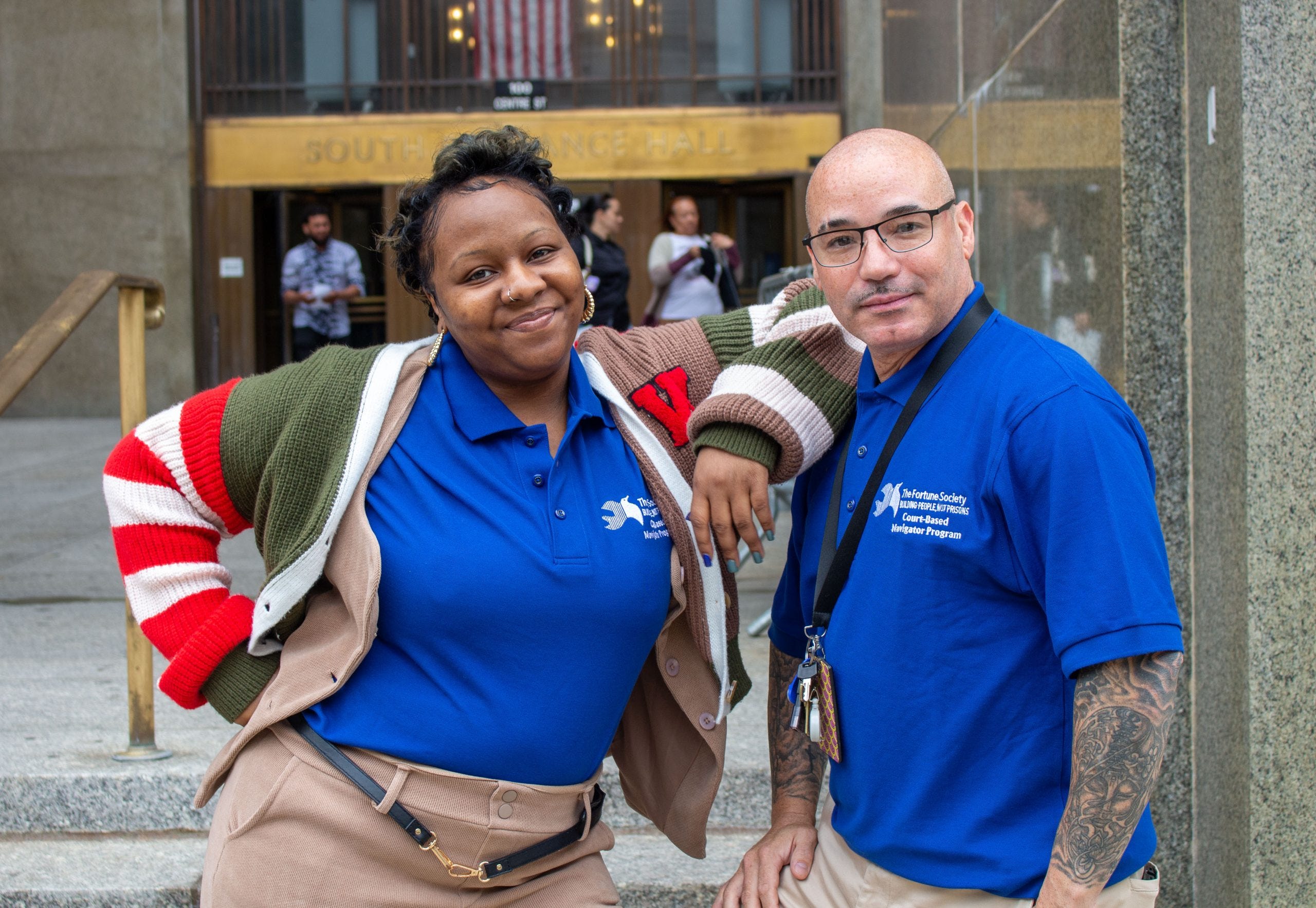
The district attorney also funds Fortune Society court navigators, who connect people leaving arraignments with food, clothing, housing assistance, and treatment.
After the home, the second most common location for crimes I heard was the train. Jonathan Jimenez appeared for assault in the third degree. He was accused of following the complaining witness through a car change on an empty train and punching him in the face, causing bleeding and a split lip. A witness had pointed him out to police in an encounter the police did not stage.
Jimenez, who wore a teardrop tattoo, had an open case regarding an unprovoked punch at a Burger King. One violent felony, three felonies, and more misdemeanors. About the evidence, Jimenez’s attorney argued “this is essentially a game of telephone.” Counsel cited his score of 25 out of 25 on the NYC Criminal Justice Agency’s release assessment, which estimates whether a defendant will return to court.8 It recommended release on recognizance. “Not a flight risk!”
“I would like a little more contact,” said the judge. Tier 1, Level 2 supervised release.9
Montrae Raven was my last case of the night, “menacing in the second degree.” At 9:45 p.m., a security guard found Raven on the subway tracks and told him he couldn’t be there. Raven allegedly pointed a gun at the guard and said he would shoot him.
The defense said a full order of protection would be too burdensome because—in substance—everyone in New York uses the train. The judge agreed. Raven had two open cases, a petty larceny, and failure to appear. His attorney argued that his living situation made contact with services difficult and asked for release on recognizance. The judge wanted multiple ways to get in contact with Raven and ordered Tier 1 supervised release, a limited order of protection, and a referral to CASES.
My textbook understanding of prosecution and defense did not prepare me for the experience of the post-punishment court. Again and again, the defendant’s housing, employment, treatment, and willingness to answer the phone became the principal problems for the room to solve. Judge, prosecutor, defense attorney, and program staff shared a goal of helping the defendant build a better life. Harms to the complaining witness and risks to public safety rudely intruded as complications to work around.
CR-030333-26NY. I observed arraignments on Saturday, October 17, 2026, during the night-court session (5 p.m.–1 a.m.). Electronic recording devices were not permitted in the courtroom. Case numbers were abbreviated, so I cross-referenced my notes with WebCrims.
NYCHA’s LaGuardia Houses, in the Lower East Side/Two Bridges area.
A ‘part’ is a designated courtroom.
Avenues for Justice presented Bragg with its Andrew Glover Justice Award at its October 2024 “45 Years of Second Chances” gala. The organization reports that Bragg and fellow honoree Dede Agar agreed on prioritizing resources and services for young people to reduce repeat offending.
The Human Resources Administration administers help paying rent and determines eligibility for supportive housing. Supportive housing comes with staff who help tenants apply for benefits, manage medication, and obtain mental-health or addiction treatment.
Deliberately breaking a court order is itself a crime. An assault can therefore bring another charge if it also violates an order of protection.
Under the city’s 2026 supervision guide, Tier 2 is “enhanced” supervision, with at least five required contacts during the first month. Level 5 calls for one in-person check-in each week.
A 2025 study found that the CJA assessment recommended recognizance in 88% of assessed cases from 2021–2023, including 79% of violent-felony cases.
One telephone check-in and one in-person check-in per month, under the 2026 guide.