


In 7 Years until the Great Reset of 2030, My Patriot Supply warns us about the breakdown in traditions like “buying DVDs” and their replacement by practices—like subscribing to a media streaming service—which threaten people who “pride ourselves on our self-reliance and self-sufficiency.” I recommend reading it in full.
Their sales pitch for emergency supplies really resonates with a certain type. Whether one calls it a hobby or a worldview, their focus is on competitive survival—“prepping.” The more strongly respondents endorsed this competitive-survival outlook, Fetterman and colleagues found, the less willing they were to admit being wrong.1
Consider two ways of packing for travel. The cynic packs heavy, expecting others to take advantage—to resist an environment which tries to dominate him. The optimist expects cooperation: somebody will sell food, wash clothes, and explain how things work. One prepares for collapse, while the other prepares to exploit the environment.
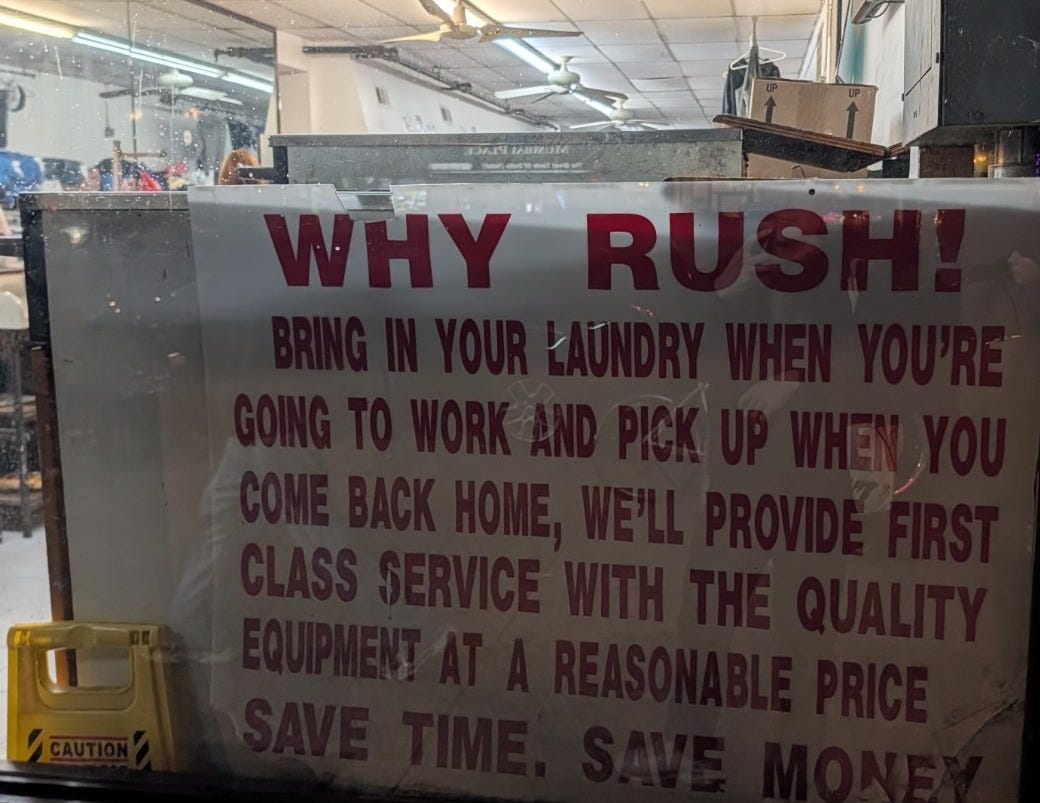
If this reliance on strangers sounds a bit gay, that’s because it is! I’m happy to leave a bag of intimates on a launderer’s counter, ask when they’ll be ready, and go out wearing the other set.
Some of this intercourse with The Other may involve the exchange of currency. In this way, I have not guarded my sacred reserve. The merchant has made money off me. I have made a more comfortable trip off him.
How many accoutrements do you require on your body to maintain a stable sense of self?2 Packing light requires you to ask what really matters.
When the researchers approached Reddit’s prepper community, commenters accused them of trying to make preppers look ridiculous. They were also told that true preppers would never answer a questionnaire. Adam K. Fetterman, Bastiaan T. Rutjens, Florian Landkammer, and Benjamin M. Wilkowski, “On Post-Apocalyptic and Doomsday Prepping Beliefs: A New Measure, Its Correlates, and the Motivation to Prep,” European Journal of Personality 33, no. 4 (2019): 506–25, table 4 (Study 1) and discussion of Studies 6a–6b.
Hyde and Olesen interpret familiar possessions, including photographs, favorite soap, music and pajamas, as supports for a continuing private self-narrative in unfamiliar surroundings. Packing also prepares a public performance through clothes and other props. Both projects compete with freedom of movement: the reassuring possessions still have to be carried. Their account suggests that deciding what to leave behind can involve deciding how much continuity a traveler needs. Kenneth F. Hyde and Karin Olesen, “Packing for Touristic Performances,” Annals of Tourism Research 38, no. 3 (2011): 900–919, “Rituals to Maintain the Private Self-identity Narrative,” “Freedom of Movement,” and “Packing Light.”