


The Schwarzman library is a Beaux-Arts marvel that would be hard to build today. The Landmarks Preservation Commission counts its reading rooms “among the finest public interiors in New York City”: Vermont marble, bronze railings, hinges topped with pineapples, and hand-drawn fixtures worked over by artisans from Germany.
Architecture and materials engineering have advanced plenty since then. But ascetic objections to grand public projects have hardened. This cynicism is quite old. John 12:5 tells of Judas Iscariot’s protest against Mary pouring essential oils onto Jesus’s feet. “Why wasn’t this perfume sold for a high price and the money given to the poor?”
But the paradox of poor relief from the late modern period is how it demoralizes that class which is just above the eligibility cutoff for relief.1 So, means-tested social welfare legislation tries to set good incentives. The 1937 Housing Act that commissioned federal housing projects in the U.S. paid only for projects that “will not be of elaborate or expensive design or materials,” capped2 at $1,2503 per room.
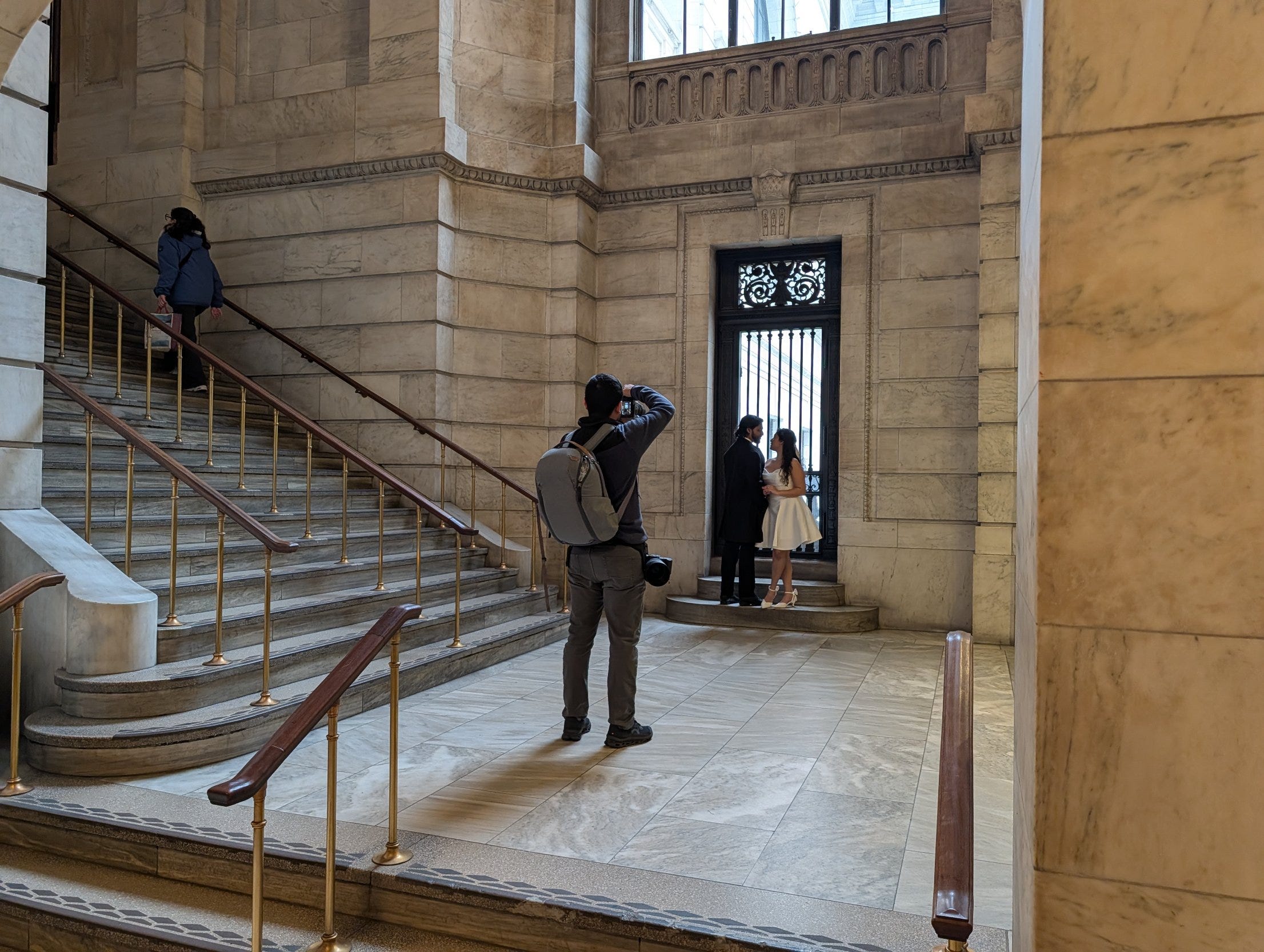
How did this New York Public Library building—so beloved as a background that you will find couples taking wedding pictures here at all times of day—escape this aesthetic nerfing? The NYPL does not discriminate against billionaires or trillionaires. Its trustees dedicated the library “for the free use of all the people.”
The thorough security presence at the NYPL ensures this freedom can be exercised by all the people, as contrasted with a public park which yields to private domination. I suspect a higher demand for taking pretty photos than for scholarly study. The benefits of a Beaux-Arts Instagram backdrop are not a hard sell to the masses.
Selling marble to legislators may be another matter. When the public purse can’t justify the ornament, a donor can buy the name. The building in my photo was renamed for a $100 million gift from the CEO of the Blackstone Group. Yes, the private equity firm buying up single-family homes. Thank them for the memories.
See for example how Britain’s Poor Law commissioners found in 1834 that “Throughout the evidence it is shown, that in proportion as the condition of any pauper class is elevated above the condition of independent labourers, the condition of the independent class is depressed; their industry is impaired, their employment becomes unsteady, and its remuneration in wages is diminished. Such persons, therefore, are under the strongest inducements to quit the less eligible class of labourers, and enter the more eligible class of paupers.”
The American Institute of Architects’ housing chairman argued that federal housing was “better than that in which many hundreds of thousands of taxpayers can afford to live,” and “through taxation they were forced to pay for housing accommodations more elaborate and more costly than necessary.” Walter R. McCornack, “The Beginning of a Great Building Program,” The Octagon, August 1937, p. 4.
$1,250 in 1937 is about $29,300 in October 2026 consumer prices (BLS CPI-U, 14.4 to 337.511). Economic historians prefer wage measures for building projects, which makes it higher.