


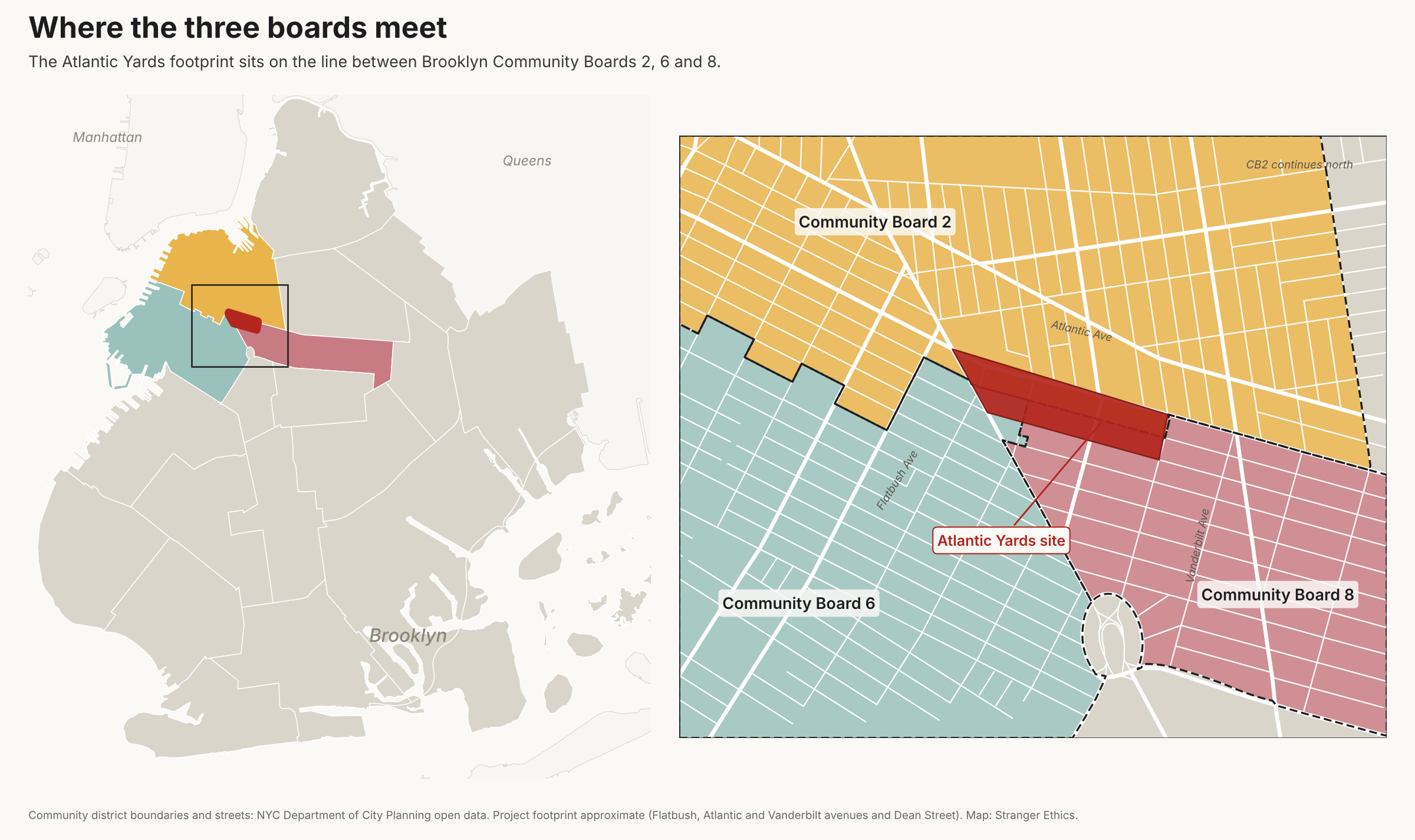
How do you get new housing past a community board? If the opposition is about who the neighborhood is for, the answer might be a little this-for-that. When Forest City Ratner proposed an arena and towers over the Vanderbilt rail yard in 2003, the three community boards around the site lined up for the city’s land-use review process (ULURP), where developers hand out goodies to win the goodwill of gatekeepers.
But there was a twist: about 40 percent of the site belonged to the state of New York. The city determined in 2005 that it couldn’t make the state put its own land through ULURP. This bypass took away the boards’ leverage, but the project still had to win over the Albany-level gatekeepers: the governor and the two legislative leaders on the state board that gave final approval. To win them over, Forest City struck a few deals.
The first counterparty was BUILD, a jobs group which asked for a pipeline into the construction work: a training program, with public-housing residents first in line. ACORN’s Brooklyn chapter asked for half the rental housing to be below market rent, in exchange for a promise to “take reasonable steps to publicly support the project.” When that deal was signed in May 2005, ACORN’s Bertha Lewis kissed the mayor.
Forest City’s spokeswoman summed it up: “We have ACORN, we have BUILD […] It’s pretty much all of Brooklyn”—eight groups signed on in June 2005. Minority contractors got a fifth of construction dollars set aside through a private agreement. A city program would have needed a disparity study to set racial goals like these.1
Neighbors opposed to the project’s scale and its use of eminent domain had organized as Develop Don’t Destroy Brooklyn, but by now, Forest City was ready for the fight.
The community boards held their hearings in August 2006, where supporters outnumbered opponents at the microphone more than two to one. The project’s most persistent critic, Norman Oder, wrote that most supporters other than union members were Black and most opponents white. That December, the state’s Public Authorities Control Board approved Atlantic Yards unanimously. When asked about negotiators from away, a BUILD representative answered: “We’re really working for strangers.”
The agreement says the developer will “seek to award” 20 percent of construction dollars to minority-owned firms. City of Richmond v. J.A. Croson Co. (1989) requires state and city racial contracting goals to rest on findings of discrimination; New York City rebuilt its own program in 2005 on a disparity study.