


For eight weeks my Monday nights were eaten by a survey course in New York City law. No more kimchi-making classes; no other decadent “consumption” activities; just poring over a bill “prohibiting the sale of guinea pigs in pet shops.”
The law itself is two sentences.
Why had I never tried to read legislation from beginning to end? The drama of politics always fascinated me, but doing politics felt inaccessible. It also felt indispensable for sticking the landing in a city like New York.
These mean streets famously chew up and spit out the apolitical transplant naïf who pays $4,000 a month for a shoebox, only to fly home after a year. A majority of NYC’s rental housing is non-market; incumbents who know how to play the game pay closer to $1,650. The first way to lose at politics is to not show up and curse the arena.
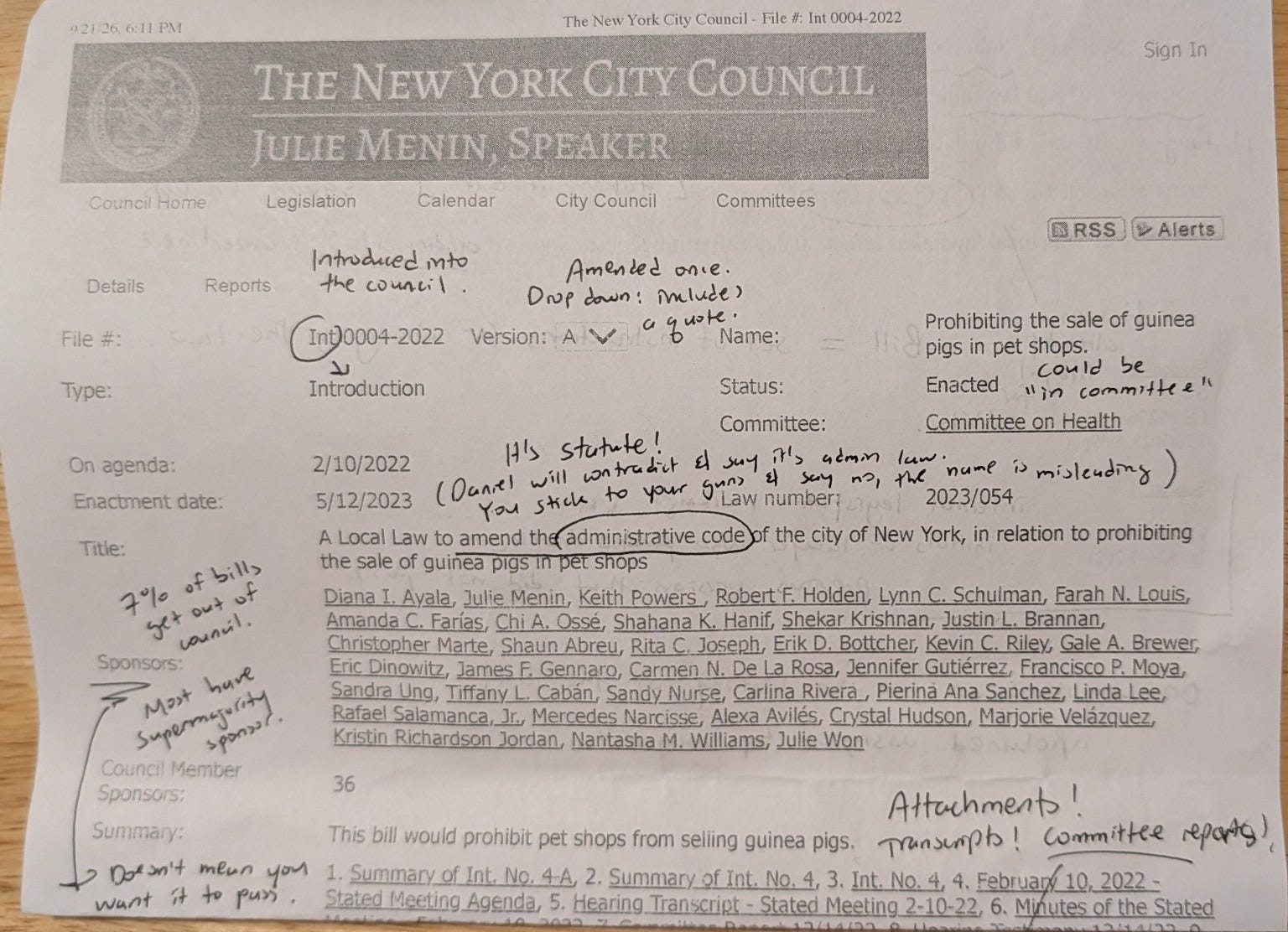
Daniel Golliher’s shepherding got me past the first ick: reading the law. A different inhibition remained—I didn’t feel qualified to testify at a public hearing. The cure was to watch officials record a tower of ignorant remarks against building new housing in Brooklyn. Real politics happens every day in rooms the genteel cede to the scrappy.
Foundations of New York is heavy on writing and memorization, so I took it as a forcing function to build a daily practice for Stranger Ethics. A few posts are lightly massaged versions of my class assignments, or began with a spark from an assigned reading:
The Repeat Business of Catch-and-Release was a field report from a criminal justice process that the public has constitutional right to witness.
Frances Willard’s Serial Moral Entrepreneurship was my attempt to make sense of the timing of certain amendments to the U.S. Constitution a century ago.
The T in MTA Stands for Transportation was literally titled as a mnemonic for a required-correct question on the final exam.
Most of my cohort were accomplished in private endeavors but had no professional experience in government. Some had hoped against hope that candidates like Alex Bores, who campaigned on AI safety, could beat established endorsement networks.
The election stories that had captured us focused on big ideas or big personalities. To understand a result like Micah Lasher’s win over Bores as normal politics, rather than a cosmological triumph of evil over good (or as “corruption”), we had to study the social technology of party clubs and lobbying without fear or taboo.
One teaching tool was roleplay. Classmates circulated designating petitions, the forms candidates use to get on a party’s primary ballot, and Daniel proceeded to disqualify swaths of signatures for party-enrollment or residency reasons. These rules that The Man uses to keep you down: where are they written? How are they formed?
The seminars followed the interests of the people in my fall 2026 cohort. Some were organizers already, and we got a front-row seat to Bryce Rogers and Megan Lagerquist testifying for the RAD Collective at the City Council’s blockbuster AI risks hearing.
Others just want to do right by their friends and the law. One classmate’s epic about a friend’s four-year attempt to legalize an apartment conversion did not end with a “somebody should do something about this,” as it might have without the class. He identifies the specific permitting regulations that punish homeowners who try to comply. The Department of Buildings may be receiving a petition for a rule change.
Learning law and history transforms the kvetch into a call to action. Why, I have also wondered, can you leave a car at the curb but have your bicycle confiscated? David K went looking for the legal distinction and found two failed bills he proposes reviving.
The Monday after the midterm, Daniel invited us to notice how much the room had thinned out. Everyone still here, he noted, had passed. He thumbed through a stack of Further Reading, from An Introduction to the NYC Rent Guidelines Board and the Rent Stabilization System to Gibson’s New York Legal Research Guide, fourth edition.
“It’s not that friendly to beginners. But you’re not beginners anymore.”